





.jpg)




.jpg)


.webp)

.jpg)
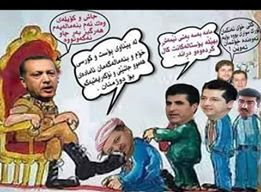
In fact, the Kurds opposed the Islamic Republic on the grounds that they had already established ties with Turkey. Turkey changed the issue in favor of Ankara's policy by providing money to party leaders such as Abdullah Muhtadi, Mustafa Hijri, and Hussein Bakhshi of Barzani's party.And let's not forget that there are 137 Turkish military bases in the areas under Barzani's control, 30 of which are Turkish special intelligence forces. Therefore, Kurdish parties like those mentioned are under the umbrella of Erdogan's special forces.
In fact, those who caused Mr. Trump's change of opinion were Mustafa Hejri and Hossein Yazdanpanah in the first stage and Abdullah Mohtadi, the 80-year-old leader for life, in the second stage, and in fact Mustafa Hejri was also the 81-year-old leader for life, who caused the US policy towards Iran to change. Another issue also plays a role in these issues, namely America's turning its back on the Syrian Kurds.

Deep Dive: Despite fickle interest, Iranian Kurdish dissidents seek US support.
Only six days after Israel and the United States initiated war on Iran on Feb. 28, US President Donald Trump told reporters that it was “wonderful” that Iranian Kurdish opposition groups were ready to move against the Islamic Republic, and that he would be “all for it.” Two days later, he told those same reporters that he did not want the Kurds to go into Iran. The war, he said, was complicated enough as it is.
Those 48 hours echoed a decades-long pattern in interactions between America and many Kurds: apparent US support followed by abrupt withdrawal with no explanation. The call for the Coalition of Political Forces of Iranian Kurdistan, a new umbrella entity formed in February, to intervene in cooperation with the CIA—and the swift policy reversal by the White House—confirmed this tendency.
The leader of the Komala Party of Iranian Kurdistan, Abdollah Mohtadi, warned his forces not to be “sent to slaughter,” a statement best read not as a withdrawal but as a negotiating posture geared to prevent a repetition of the past. These dynamics reveal three structural questions: What conditions generate American demand for Kurdish partners? What conditions sustain Kurdish engagement with the US? And what does this architecture reveal about the limits of those relationships?
Why the US keeps working with Kurds
The Trump administration’s consideration of Kurdish allies as an effective ground force revolves around capability and cost. The US aims to maintain influence in a region that is challenging for large-scale intervention and limited by the lessons of Afghanistan and Iraq, as reflected in domestic public opinion in America. Against this backdrop, Kurdish military forces are hard to replace: motivated, with a territorial force with strong ideological commitment and a readiness to absorb casualties without provoking political fallout in Washington.
Indeed, the 11,000 fighters of the Syrian Democratic Forces (SDF) who died fighting the Islamic State group (IS) between 2015 and 2019 are not tallied in American casualty statistics. Peshmerga losses in 2003 did not lead to congressional inquiries in the US. Any incursion into Iran from the Zagros Mountains in 2026 will not be included in US fatality records either. Kurdish forces endure the human cost in exchange for American military power, creating a structural asymmetry in their relationship.
The second factor is vacancy logic. US support for Kurdish actors arises when alternatives collapse. Turkey’s refusal to allow its territory to be used in the 2003 American-led invasion of Iraq left Iraqi Kurdistan as the only viable northern ground corridor. The collapse of CIA-trained Syrian Arab forces in 2014 ultimately made the SDF the only force capable of holding territory against IS. In the 1970s, the CIA and Shah Mohammad Reza Pahlavi backed Kurdish fighters as a proxy to pressure Iraq without direct Iranian involvement. In 2026, outside the Kurdish coalition, there are no organized alternatives with comparable reach into Iran. Kurdish indispensability is structurally constructed, not a preference.
However, the consequence of vacancy logic is that US support emerges under urgent conditions, thereby systematically weakening Kurdish leverage. American interest peaks at the moment of recruitment, precisely when Kurdish bargaining power is highest—but urgency compresses the negotiating window. The SDF was informally integrated into US operational plans without formal frameworks, enabling a simpler withdrawal, as seen in January this year. Kurdish political demands for security guarantees and constitutional recognition tend to intensify as the operational relationship deepens, exactly when American urgency has already declined.Why Kurdish actors work with the US
Kurdish engagement with American power, despite its evident limits, is driven by the arithmetic of alternatives, internal competition and a calculated assessment of what an imperfect partnership yields.
For Iranian Kurdish opposition parties, the alternative to American engagement in the current context is not a more reliable patron; it is operating without external support or air cover against the Islamic Republic. Following reports of US outreach to its Kurdish foes, Iran reportedly hit positions in Iraqi Kurdistan associated with most exiled opposition parties. The question Iranian Kurdish dissidents face is whether the risks of American support are more manageable than those of operating without it.
Mohtadi’s statement about not sending forces to slaughter was thus a negotiating stance: conditionally engaged, risk aware and reserving the right to adjust. It reflects an actor attempting to control exposure rather than reject the relationship. Whether this posture is sustainable without institutional backing, particularly when conditions shift, is the central question.
Internal Kurdish competition adds further complexity. The opposition coalition announced in February took eight months to negotiate. It brings together ideologically diverse parties with separate military commands and histories of mutual suspicion. Its formation was driven not only by external pressure but by the need to avoid worse terms through fragmented engagement. Yet the same competitive dynamics that made coalition-building difficult also threaten its coherence: access to US weapons and coordination offers advantages in intra-Kurdish rivalry, independent of the broader political value of a relationship with Washington.The deeper reason for sustained Kurdish engagement is historical. The Republic of Mahabad, declared in the eponymous Kurdish-majority city in western Iran in 1946, lasted eleven months before Iran crushed it, with no external protection. The Kurdistan Regional Government in northern Iraq survived through the 1990s under the Anglo-American no-fly zone, only gradually gaining constitutional status, economic connections and international recognition. The SDF controlled a large territory in northeastern Syria with US backing; it later diminished through withdrawal but has not been erased: a deal with Damascus was facilitated partly by residual US leverage. Engagement has consistently produced more durable outcomes than isolation. Managed dependency has appeared preferable to unmanaged exposure.
The structure that contains both
The relationships between Kurdish actors and the US produce recurring results not because of the character of the players involved but because of the structure of the international system. That system is organized around state sovereignty and has developed no adequate institutional category for non-state political entities that exercise territorial control, maintain military forces and articulate political claims that would, in any other context, constitute attributes of statehood. Kurdish political actors exist in that gap: capable enough to be indispensable when states need them, yet without the legal standing to access the institutional protections statehood provides.
The US cannot make formal commitments to Kurdish entities because its institutional framework contains no mechanisms for treaties or alliances with non-sovereign actors. What Kurds receive instead are verbal assurances, informal understandings and a military presence, which can be revoked at any time without a formal process, as President Trump demonstrated by reversing his stance on backing Iranian Kurds within 48 hours, without congressional or diplomatic notice. Beyond individual decisions, Washington’s structural commitments—including under NATO, bilateral agreements with Iraq and Turkey and obligations flowing from the terrorist designation of the Kurdistan Workers’ Party (PKK)—exert pressures independent of presidential preference.
The dynamics in Iraqi Kurdistan in the 1970s accurately illustrate this logic: CIA support for Kurds was a function of Cold War geometry whereas the US-backed Shah’s interest lied in pressuring Baghdad over border demarcation. So when the 1975 Algiers Accord ended the Iran-Iraq territorial dispute, serving both American and Iranian interests, the US adapted without hesitation because the relationship with Iran was the principal commitment. The ultimate outcome was forceful military action by the Iraqi central government which displaced thousands of Kurds. In 2026, when the new administration in Damascus marched on the Kurdish-led anti-IS coalition, the US leaned toward a state actor over its decade-long non-state ally. The structural equation changed; Kurdish political and military commitments were no longer variables in it.
Between 1972 and 2026, the structural logic has not changed. What has changed is that Kurdish political entities have become more developed, organized and strategically coherent. The Coalition of Political Forces of Iranian Kurdistan is a significant institutional achievement, requiring sustained effort across traditionally competing parties. It does not alter the terms of engagement with the international system, but it improves the capacity to navigate those terms. However, the conditions under which this calculus might change are not yet visible. The prospects of such an initiative, particularly in a context whereby Washington continues to operate in a system with an emphasis on state sovereignty, also remain to be seen.
Resources


Inga kommentarer:
Skicka en kommentar